Yes. You can continue to test at any of our conveniently located stations where our average wait time is less than 10 minutes. We also provide weekend and evening hours and issue DMV stickers during the same visit. DEQ TOO provides you with a second option. When your vehicle is due for renewal, you can choose between testing in-person at a Clean Air Station or via the internet with DEQ Too.
No. DEQ does not require any registration or enrollment by motorists. You simply test using DEQ Too or test at a Clean Air Station.
-
On the home page of the DEQ Too website, click on this icon:
- You'll be asked to review and agree to the terms and conditions.
- You'll be asked to enter your license plate and odometer reading.
-
Then your results will appear. Typically, you will see one of two results:
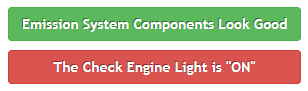
- Then you'll be instructed on how to proceed from there.
When you've paid for your DEQ Electronic Clean Air Certificate, you'll see DMV's logo which will navigate you to their online vehicle registration renewal system.
Your stickers will arrive in your mailbox within as few as 3 business days!
 DMV's online system uses USPS First Class mail which has been in place since 2004, serving almost
300,000 Oregonians annually. And if you are stopped by law enforcement while waiting for your
stickers to arrive, your printout of the online receipt can be accepted as proof of registration
payment for 30 days after you renew.
DMV's online system uses USPS First Class mail which has been in place since 2004, serving almost
300,000 Oregonians annually. And if you are stopped by law enforcement while waiting for your
stickers to arrive, your printout of the online receipt can be accepted as proof of registration
payment for 30 days after you renew.
DEQ Too uses the Sharing Economy to establish a network of businesses that will let their S-Type device be used by their customers. These businesses would be known as "Participating Locations" and their operators are the "Device Hosts". Car-sharing and bike-sharing are well known commodities within the fast-growing Sharing Economy. Not everyone needs to "own" an asset, especially if they won't be using it frequently. In the case of DEQ's vehicle inspection program, a test is only needed once every 24 months, so the sharing of emissions testing devices is an ideal asset for the Sharing Economy. These devices will only be used on location, voluntarily by a motorist or by the Host on behalf of the motorist.
Participating Host businesses already exist for a primary purpose other than transmitting OBD data. For example, if a gas station participated as a Host, their primary purpose is for motorists to refuel their vehicle. However, by using the device for a couple of minutes, motorists could take care of their DEQ too while they are refueling. The devices will only be used on location, voluntarily by a motorist or by the Host on behalf of the motorist. Besides gas stations, the other types of Hosts that DEQ envisions include, but are not limited to, auto service/repair shops, oil change shops, auto parts stores and drive-thru car washes.
Once Hosts of Participating Locations enroll, we will add them to the DEQ Too
Business Participant List
and they will subsequently show up on our Participating Locations map. You will be able to find them by clicking on this
icon on the home page of this website:
- You can use the testing device to understand why your Check Engine Light is on , but it will not pass the DEQ test in this condition. It will need repair. Once your vehicle receives repair and the Check Engine light has turned off, be sure your mechanic explains the drive cycles your vehicle must experience prior to going through DEQ's test. Otherwise, if you test too early after a repair, your test results will be "Unready"; meaning your vehicle's computer hasn't finished evaluating all of the emission control equipment.
- Read through the Terms and Conditions and these FAQs carefully.
- The newest four model years are exempt from DEQ testing, and it is dependent upon your registration expiration date. Please visit our Newer Model Year webpage Newer Model Year webpage to learn if this exemption applies to your vehicle. If for some reason you end up testing a newer model year vehicle using DEQ Too (or at a Clean Air Station), the DEQ fee will be $0.00.
- With DEQ Too, the only way to renew your vehicle registration is through DMV's Online Registration Renewal System. There are eligibility and restriction requirements for using DMV's system. Also, vehicles new to the State of Oregon cannot conduct their initial registration using the online "renewal" system. So if you meet any of these eligibility restrictions, then you cannot renew online with DMV and the DEQ Too testing option is not for you for this registration cycle.
- Only vehicles with on-board computers that store and send their electronic vehicle identification number (E-VIN) are eligible to use DEQ Too. The E-VIN allows DEQ to confirm which car is being tested and display the corresponding results. Typically, 2005 and newer model years have E-VINs; but some older models have E-VINs and some newer models do not. If your vehicle does not have an E-VIN, then the testing device used at a Participating Location will throw an error message. 2005 and newer model years currently make up about 50% of vehicles on the road. The proportion of qualifying vehicles increases with each new car sold.
There may be a device-usage fee you pay to a participating location. However, since this is an open-market approach, with several parties competing for your business, any price you're charged should be reasonable. And in some cases, there may not be any charge. Participating locations may host devices for free to attract customers over their competitors that did not enroll as Hosts.
In order for a company to provide services in the DEQ Too program, the company must meet certain terms and conditions and then get placed on the official DEQ Too Business Participants List. The types of business participants are:
- An Auto Dealership that needs to test its multiple vehicles
- A company needs to test its multiple, Fleet of vehicles
- A Host
- A Telematics Device Manufacturer
From the DEQ Too home page, the below icon will take you to the webpage for businesses interested in
joining the program.
 Then click on your business type, read and agree to the Terms and Conditions and then submit your
enrollment documentation. DEQ will make a determination within 30 days of receiving your
documentation. Or, if at this time you only wish to express interest to DEQ in becoming a
business participant
or have specific questions, then please send us an
email
with your name, business name and phone number.
Then click on your business type, read and agree to the Terms and Conditions and then submit your
enrollment documentation. DEQ will make a determination within 30 days of receiving your
documentation. Or, if at this time you only wish to express interest to DEQ in becoming a
business participant
or have specific questions, then please send us an
email
with your name, business name and phone number.
No. DEQ is intentionally not contracting this out to any single business. Instead, the DEQ Too program uses an open market, free-enterprise approach which allows multiple Businesses Participants to join as long as they meet our specifications for their business type.
The shared vehicle telematics device is one that can be shared for use by multiple vehicles, one vehicle at a time.
The only objective of the S-type device is to transmit a snapshot of each vehicle's OBD data to DEQ. The general public would use S-type devices by using them at participating locations, which exist for a primary purpose other than transmitting OBD data. For example, if a gas station participated as a Host, their primary purpose is for motorists to refuel their vehicle. However, by using the device for a couple of minutes, motorists could take care of their DEQ too while they are refueling. Besides gas stations, the other types of Hosts DEQ envisions include, but are not limited to, auto service/repair shops, oil change shops, auto parts stores and drive-thru car washes.
No. The data that comes to DEQ will be no different than the data we receive during a test at a Clean Air Station.
Our Clean Air Station inspectors are trained not to conduct a test if they see excessive smoke coming from the tailpipe of a vehicle. If a smoking vehicle somehow receives a test, our software can generally identify if an emissions component is not working and that component could be the cause of the excessive smoke. Such a vehicle would fail the computerized test in a Clean Air Station. So the same vehicle failing a Clean Air Station computerized test, would also fail the DEQ Too computerized test.
Also, when complaints come into DEQ from the public about vehicles with excessive smoke, we send a letter to the vehicle owner informing them that their vehicle is in violation. That practice will continue and in addition, the Department will be tying the complaint data to our testing databases to ensure those smoking vehicles cannot be tested through the DEQ Too testing option.
And finally, DEQ's Terms and Conditions:
- Require Auto Dealerships, Fleets and Hosts to not allow testing of vehicles with any visible smoke coming from the tailpipe.
- Authorize DEQ to make announced and unannounced visits to ensure they are complying with this.